
Criminal Court Cases in Jones County
Jones County criminal cases divide between District Court and Superior Court. District Court hears misdemeanors and infractions and conducts early felony proceedings. A felony trial belongs in Superior Court after the indictment process. Magistrates handle warrants, initial appearances, and bond functions. All three operate within the North Carolina General Court of Justice, so a municipal police arrest does not create a separate town court file.
The Jones County Clerk of Superior Court is the custodian of the official file. The counter is at 101 Market Street in Trenton and is open Monday through Friday from 8:00 a.m. to 5:00 p.m. The main number is 252-448-6220. The courthouse also houses courtrooms and, unusually, the small county jail in its basement. That shared site can be convenient, but custody staff and clerk staff still keep different records.
The official Jones County Courthouse page shows the local court location used for case files and hearings.
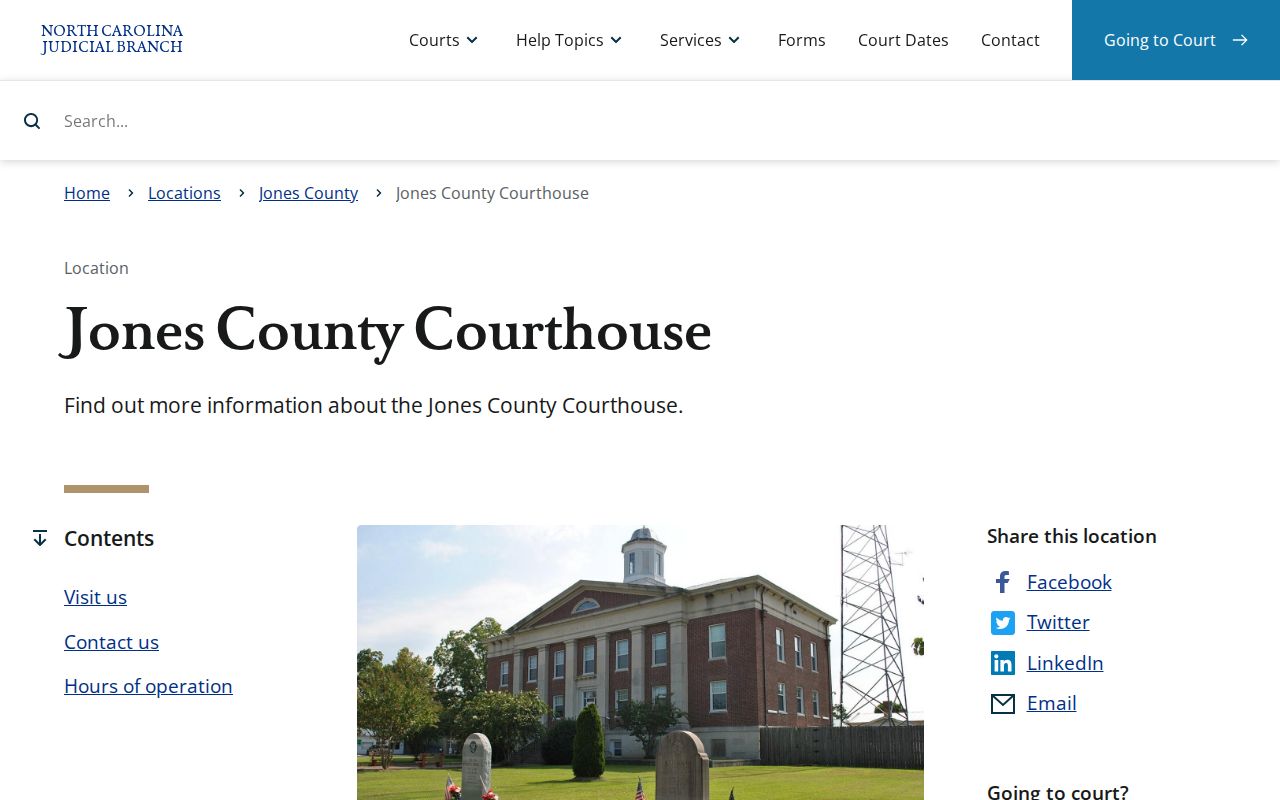
The courthouse listing points readers to the clerk and trial court, not to the sheriff, when the goal is a filed charge, court order, or final judgment.
Inside Jones County eCourts
North Carolina eCourts supplies the statewide digital framework, and its public Portal is the first remote stop for eligible Jones County criminal case records. Search modes include party name, record number, citation number, attorney name or bar number, business name, cross-reference number, and nickname. Selecting Jones as the county sharply reduces false matches. A common name alone does not prove identity.
The result can show case information, hearing entries, financial information, and public electronic documents. Some docket entries have no downloadable document. Sealed cases, expunged cases, juvenile matters, protected identifiers, and confidential documents do not appear as ordinary public results. Portal is an informational view. The clerk remains the source for an official copy and questions about archived or restricted material.
| Portal field | Type | Required | Use |
|---|---|---|---|
| Search by | Mode tabs | One mode | Choose party, record, citation, attorney, business, cross-reference, or nickname. |
| Last or business name | Text | Mode-dependent | Use legal spelling and narrow common names. |
| First and middle name | Text | Optional | Add what is known to distinguish similar names. |
| Record or citation number | Text | Mode-dependent | Enter the exact identifier when available. |
| County | Dropdown | Optional | Select Jones for a local search. |
| Case category | Filter | Optional | Choose criminal or infraction as appropriate. |
| Attorney name or bar number | Text | Optional mode | Use for a counsel-based lookup. |
| Judicial officer or courtroom | Hearing filter | Optional | Narrow dates and hearings when those details are known. |
| Search or clear | Button | Not applicable | Run the selected query or reset its fields. |
The Jones County court services page connects local users with calendars, forms, and eCourts services.
Those service links complement Portal when a reader needs a court date, form, accommodation request, or clerk contact rather than a name search.
Jones County Case Record Searches
Start remotely, but keep the file number. It is the best bridge between Portal, a phone call, and the clerk's paper or certified copy. If a name search fails, spelling, timing, an archive gap, or a protected case may be the cause. The search process should not end with one empty screen.
- Open the official North Carolina eCourts Portal and choose party name or record number.
- Enter the most exact public details available, then select Jones County and the criminal or infraction category.
- Open the likely case and compare its county, file number, charge, offense date, and court events. Do not merge same-name records.
- Read entries in date order. Separate a scheduled hearing from an event shown as completed and a charge from its disposition.
- Call or visit the Jones County clerk for certification, archived material, a missing document, or a result that conflicts with an order.
A public terminal at any North Carolina courthouse offers another channel. The Judicial Branch says those terminals can search, view, or email non-certified criminal records for one county or statewide. That free terminal search is broader than a certified Jones County name search, but it does not carry the clerk's certification.
Jones County Court Jurisdiction
Jurisdiction explains why one criminal matter may appear to move between court levels. A misdemeanor generally stays in District Court. A felony may begin with a warrant, an initial appearance before a magistrate, and preliminary District Court activity before an indictment places trial proceedings in Superior Court. The Jones County contact directory also lists District Attorney offices for Prosecutorial District 5 in Duplin and Sampson counties.
North Carolina class labels should be read with care. Felony punishment depends on the offense class, prior-record level, and the mitigated, presumptive, or aggravated range. Misdemeanor classes A1, 1, 2, and 3 have different statutory limits. A Portal charge description or class is not a sentence. Verify the offense statute and final Jones County judgment before drawing a conclusion.
The Jones County court contact directory identifies the offices tied to local case processing.
The directory is useful when a question belongs to the clerk, magistrate, judge, or prosecutorial office instead of the public Portal.
What a Criminal Case File Contains
A Jones County case file documents the prosecution as filed and the court's action. It is not a complete statewide arrest history. Portal may expose a summary and selected public documents, while the clerk's official file controls. Readers should look for the charge-level outcome because one case can contain several charges that end in different ways.
| Case number and court | Identifies the Jones County file, court location, case type, filing date, and status. |
|---|---|
| Parties and counsel | Lists public party roles, the State as prosecutor, and attorney information when public. |
| Charges | Shows filed charge descriptions, offense dates, and related agency or citation identifiers when entered. |
| Docket and documents | Records chronological events and any public electronic filings available for download. |
| Hearings | May list date, time, courtroom, judicial officer, type, and status. |
| Disposition and judgment | Shows each charge's outcome, disposition date, judgment, and sentence information entered in the file. |
| Financial entries | Shows eligible balances, fines, fees, and payment access without making the public view a certified record. |
Note: A docket entry can identify a filed item even when the underlying document cannot be downloaded from the public view.
Jones County Court Certification
Certification changes the record product, not the event. The Jones clerk can perform a $25 certified, single-county name search with form AOC-CR-314. A mail request accepts a money order or certified check. An in-person request may use a credit card, cash, money order, or certified check. Personal checks are not accepted by mail. Confirm the current form revision and any separate copy fee with the clerk.
A certified Jones result is not a national record, a complete SBI fingerprint history, or a collection of every sheriff report. Likewise, a printout does not become certified merely because it came from an official portal. For self-review of fingerprint-linked statewide criminal history, the proper route is the North Carolina State Bureau of Investigation Right to Review process.
The Judicial Branch's criminal record check instructions distinguish the paid certificate, free courthouse terminals, and the state subject-review route.
That distinction helps readers choose the right product before paying or traveling to the Jones County clerk's counter.
Criminal Case Stages in Jones County
A case can begin with an arrest, citation, or summons. A magistrate conducts the first judicial process and addresses release terms. A misdemeanor proceeds in District Court. A felony may pass through probable-cause or grand-jury steps before indictment and Superior Court arraignment. Discovery and motions follow, then a plea or trial, judgment, sentence, and possible appeal or post-conviction work.
Case flow: Charges Filed › Arraignment › Pretrial › Plea or Trial › Disposition › Sentencing
Portal events should be read in order. A future date proves only that an event was scheduled. An arrest charge may change before the prosecutor files it, and different counts can reach different outcomes. When the filed charge matters, use the Jones County court record rather than relying on the booking label. The broader transition from arrest into the case file is also covered in the Jones County arrest search.
Jones County Court Conversion
Jones County joined eCourts Track 7 on February 3, 2025, as part of a 13-county coastal conversion to Enterprise Justice and Odyssey. The statewide rollout reached all 100 counties on October 13, 2025. This milestone changed remote public access, but it did not make every older Jones County file or document instantly downloadable.
Cases that cross the conversion date can combine older paper or archived practice with newer digital entries. If Portal displays a case summary but not the needed filing, record the file number and ask the Jones clerk whether the item is archived, paper-only, confidential, or available as a copy. That is a normal fallback, not proof that no document exists.
The official eCourts overview documents the statewide system that now serves Jones County.
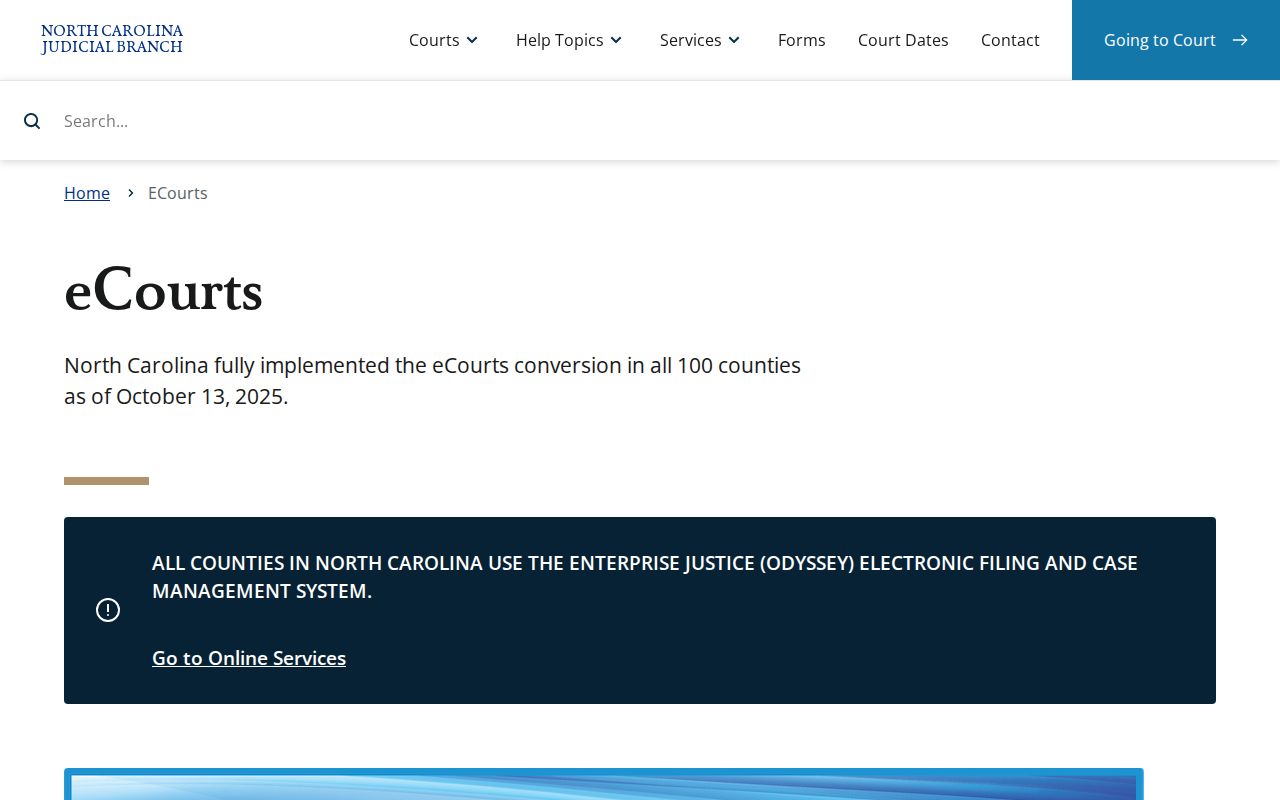
The statewide page gives context for Jones County's digital records while the local clerk remains the authority on the actual case file.
Reading Jones County Court Events
Several court terms carry precise meanings. An arraignment is the proceeding where a charge and plea are formally addressed. A disposition is the final outcome of a charge. A dismissal ends that charge without a conviction, while an acquittal is a not-guilty determination. A nolle prosequi means the prosecutor chose not to proceed at that time. These outcomes should not be treated as interchangeable.
- Docket
- The chronological list of Jones County case events and filings.
- Indictment
- A grand jury's formal felony accusation, often marking the path to Superior Court.
- Disposition
- The outcome entered for an individual charge, such as conviction, dismissal, or acquittal.
- Judgment
- The court's formal ruling, including the sentence when a conviction occurs.
- Order for arrest
- A North Carolina process commanding arrest, often issued after a failure to appear.
Read charge by charge and date by date. If a later order conflicts with the public screen, the clerk can explain access, correct a clerical issue, or supply the official Jones County record.
Access Rules for Case Records
G.S. 7A-109 generally opens clerk records to inspection, subject to statutes, court rules, and protected matters. That access does not expose sealed or expunged cases, confidential juvenile material, protected personal identifiers, victim-sensitive information, or documents restricted by law or court order. Online access can be narrower than access to an ordinary public item at the counter.
Jones County court files and law-enforcement investigation files follow different rules. G.S. 132-1.4 excludes criminal investigation and intelligence records from the general public-record definition while preserving access rules for listed incident and arrest information. The clerk cannot supply a sheriff's full investigative file, and the sheriff cannot certify a court judgment.
For an expunged Jones County matter that still appears in a government system, obtain the order from the originating clerk and contact the office responsible for that specific record. The SBI Right to Review process is the official way to inspect one's own statewide fingerprint-linked record and challenge a mismatch or missing disposition.